


Last week, I was in Washington, DC, for the Water Research Foundation’s Collaborative Water and Wastewater Utility Forum on Data Centers. The room included utilities already serving substantial data center development, alongside researchers, consultants and others trying to understand what this growth means for water systems.
WRF organized the discussion around very practical problems; such as, demand forecasting, supply planning, treatment, water quality, rates, technology and energy.
One observation during the discussion caught my attention.
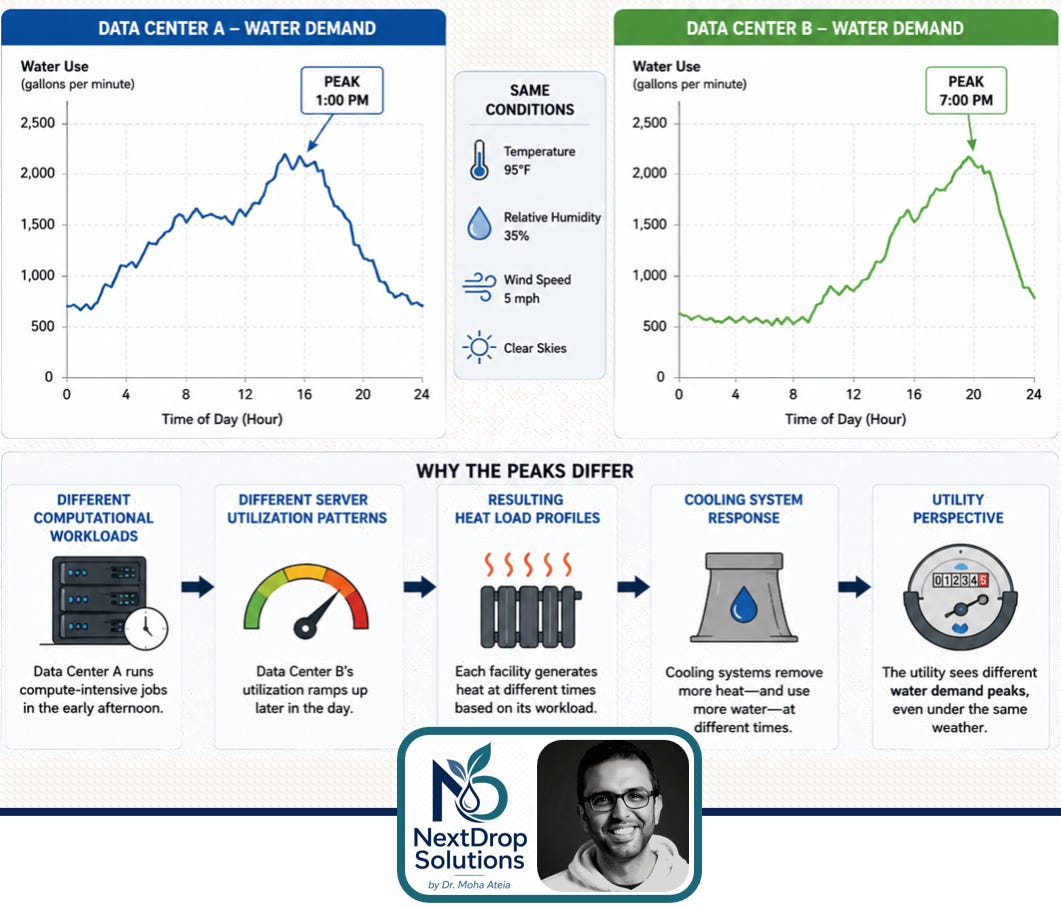
A utility with extensive data center operating experience described data centers in the same area reaching their highest water demands at different times. Based on the data available to them, there was no sufficiently reliable pattern for predicting exactly when an individual facility would peak.
For a water utility, that is a consequential uncertainty.
Today, we know quite a bit about what drives water use. The usual starting points make engineering sense. Climate matters. Cooling technology matters. A data center using evaporative cooling in a hot, dry climate presents a different water-demand profile from a facility using dry cooling or a different thermal-management architecture. Seasonal conditions therefore belong in any serious water-demand forecast.
And peak demand is receiving more attention. A 2026 analysis focused specifically on the water-system capacity implications of data centers, arguing that average or annual consumption can obscure the infrastructure required to accommodate peak withdrawals.
But there is another variable inside the facility.
Compute.
Almost all electricity consumed by IT equipment ultimately appears as heat that the thermal-management system has to remove. How that translates into water withdrawal depends on the facility, its cooling architecture, controls and operating conditions.
The connection between computational activity and water use is established in the research literature. A 2025 Lawrence Berkeley National Laboratory-led study examined water consumption at the workload level. It identified server efficiency and utilization, cooling-system type, infrastructure efficiency, climate, inactive-server percentage and refresh cycles among the factors determining water consumed per computational workload. Across the combinations evaluated, workload-level water use varied enormously.
That research is primarily concerned with understanding and improving data center water efficiency.
The utility sees the same physics from the other side of the meter.
This means that workload can become an unobserved demand variable.
Imagine two neighboring data centers on the same August afternoon.
They experience essentially the same outdoor temperature and humidity. They may receive water from the same utility. Their seasonal conditions are nearly identical.
Inside the buildings, however, they can be doing very different things.
Server utilization can differ. Hardware can differ. Cooling architectures and controls can differ. Computational activity can vary through the day. Each facility therefore produces its own thermal load, and its cooling system translates that load into a facility-specific water-demand profile.
The utility typically sees the result at the meter.
That creates an interesting asymmetry. For the data center, computational workload is an operating variable. For the water utility, it can become an unobserved demand variable.
That distinction helps explain why predicting data center water demand may be harder than applying a seasonal adjustment to an annual estimate.
I want to be careful here. The observation that neighboring facilities peak at different times does not establish computational workload as the cause. Cooling configuration, control strategies, storage, maintenance, water-management practices and other facility-specific factors can also contribute. The operating observation I heard at the forum is therefore better treated as a question worth testing against data.
But it is a particularly useful question for utilities.
So, the timing changes the infrastructure problem.
A utility ultimately has to design for a demand curve, not an annual volume.
Suppose five large data centers are connected to a reclaimed-water system. If their maximum cooling-water demands consistently coincide during the hottest hours of summer, the utility may need substantial treatment, pumping, storage and conveyance capacity to serve a relatively short peak.
If those facilities peak at different times, diversity in their demand could reduce the aggregate system peak.
That would be good news, provided the diversity is sufficiently predictable to design around.
The uncomfortable case is an aggregate peak that utilities cannot yet characterize because facility operating patterns are poorly understood. Conservative design can address uncertainty, but additional capacity has a cost. Treatment trains, pumps, pipelines and storage tanks cannot be resized every time the assumptions behind a data center forecast change.
This is why the timing question deserves more attention alongside the much more visible discussion about gallons per day.
Moving forward, utilities may need a different kind of operating dataset.
Regions with established data center clusters now have something particularly valuable: years of meter data.
The next analytical step could be quite practical. Compare high-resolution water demand against weather, facility cooling configuration, operating mode and whatever appropriately aggregated load information operators are comfortable sharing. The objective is not for a utility to know what is being computed inside a data center. It is to determine which observable variables actually explain the demand curve.
There are obvious complications. Operators have legitimate concerns about commercially sensitive information. Cooling systems differ substantially among facilities. Hardware and operating practices change. A relationship identified at one campus may have little predictive power at another.
Even that result would be useful.
Utilities could learn whether facilities fall into recognizable demand archetypes, whether weather explains most of the variability, whether computational load materially improves forecasting, and whether apparent diversity among neighboring facilities persists over enough years to influence capacity planning.
I came away from the WRF forum thinking that our data center water discussion is becoming more operational.
“How much water will this facility use?” remains necessary.
For utilities deciding how much treatment, pumping, storage and reuse capacity to build, another question is becoming equally interesting:
When will it need the most?
The answer may require connecting two datasets that have largely lived on opposite sides of the meter.