


A blood sample goes into the laboratory. Microplastic particles are reported. The result makes a headline.
The next question sounds straightforward: where did those particles come from?
Drinking water? Food? Indoor air? Some combination of all three?
At the moment, the science cannot answer that question reliably.
That disconnect is what we called the intake–detection gap in our recent Environmental Science & Technology article. We can measure microplastics in air, water, food, and increasingly in human matrices such as blood. What remains poorly connected is the pathway between those measurements.
This distinction matters because microplastics research has entered an unusual stage. Analytical capability has moved far enough that detecting particles inside the human body is increasingly feasible. Interpretive capability has not kept pace.
That is how technically complicated measurements become very simple public narratives. A credit card of plastic consumed every week. A plastic spoon in the brain. These comparisons are memorable precisely because they collapse several layers of uncertainty into something immediately understandable.
The science is harder, and much more interesting.
Let’s start with the particles we are actually measuring!
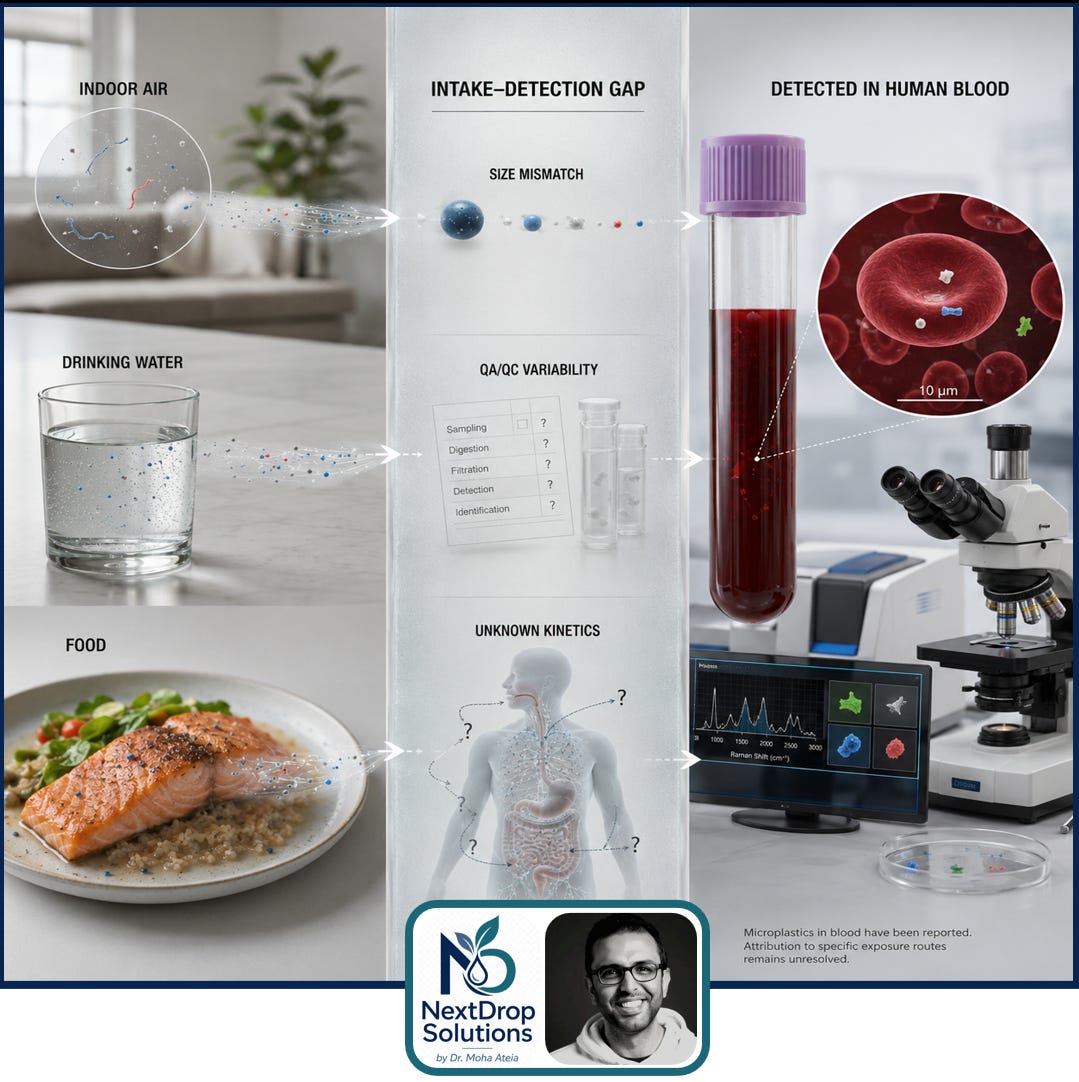
One of the first problems appears before toxicology even enters the discussion.
Environmental exposure studies and human biomonitoring studies often measure different particle populations.
A drinking-water study may quantify particles above a particular micrometer cutoff because that is where the analytical method performs reliably. A blood study may report particles in a substantially different size range. If the two measurement windows barely overlap, comparing the resulting particle counts creates an apparent exposure-to-blood relationship that the measurements themselves cannot establish.
This is particularly consequential for the smallest particles. Biological transport across the gut, lung, and other barriers is strongly size dependent, yet the submicrometer and nanoplastic fractions remain among the hardest portions of the distribution to characterize consistently. Our Perspective therefore treats size-window alignment as a prerequisite for meaningful cross-matrix interpretation, rather than another item in the methods section.
For environmental scientists, this should sound familiar. A concentration is only meaningful in relation to what the method was capable of seeing.
Microplastics make that problem unusually visible because changing the lower size cutoff can change the particle population being counted.
Therefore, we tried connecting exposure to blood.
Rather than treating this as a conceptual problem alone, we asked whether the existing literature could support even a basic quantitative connection.
We compiled 221 datapoints covering air, drinking water and beverages, food, and human blood. Studies were screened for polymer confirmation, blanks, detection limits, digestion procedures, replication, and other QA considerations.
Even after that screening, the environmental measurements were extraordinarily heterogeneous. Between-study heterogeneity remained around 98 to 99 percent across air, water, and food. Restricting the analysis by QA tier, analytical method, and particle-size cutoff did not make that variability disappear.
That result deserves attention.
It suggests that the problem cannot be solved simply by collecting a larger pile of concentration measurements. Two technically defensible studies can still describe very different particle populations because of sampling location, matrix preparation, size range, morphology classification, analytical recovery, environmental context, and other differences that are poorly harmonized across the literature.
We then reconstructed daily particle intake using Monte Carlo analysis.
For adults, the Tier 1 baseline produced a median estimate of about 2,687 particles per day. For children aged 6 to 12, it was about 1,061 particles per day, with children having the higher body-weight-normalized intake. Inhalation and dietary ingestion both contributed substantially, while drinking water and beverages contributed less on average in the reconstructed particle-number intake.
That last result requires restraint.
It does not establish that air is the dominant source of microplastics detected in blood. It does not establish that drinking water is unimportant. And it does not convert particle counts into health risk.
The intake distributions are broad, the underlying measurements are heterogeneous, and the particle populations entering each calculation are not perfectly aligned.
This is exactly where exposure science can get ahead of itself.
So, similarity is useful, but it is not source attribution!
We also compared polymer and particle-shape fingerprints from air, water, food, and blood.
Air often showed the smallest compositional distance to blood. Food was generally more dissimilar, particularly for particle shape. Yet the uncertainty intervals overlapped substantially among several routes.
There are several plausible explanations.
The external exposure mixture could differ from the fraction that actually crosses a biological barrier. Some particle sizes or shapes may translocate differently. Others may be retained or cleared differently. Laboratory methods may recover some particles more efficiently than others. Blood itself represents a transient compartment rather than total body burden.
A polymer fingerprint in blood therefore cannot presently function like a chemical source tracer.
This is an important distinction for researchers trying to identify intervention points. If a blood measurement cannot yet distinguish inhalation from ingestion with reasonable confidence, it cannot tell a utility, food producer, building operator, or regulator which pathway should receive priority.
So, the missing variable may be time.
The pharmacokinetic part of the analysis exposed another major uncertainty.
A blood concentration depends on more than intake. Some fraction of particles must cross into systemic circulation, and those particles must remain there for some period before being cleared or redistributed.
Human values for those parameters are poorly constrained.
We therefore tested combinations rather than pretending that a single value is known. Using the observed cross-study median blood concentration of 2.47 particles per milliliter, compatibility with reconstructed intake became appreciable mainly under combinations involving relatively low but non-zero systemic translocation and longer clearance half-lives, approximately 30 to 60 days within the range we evaluated.
That is a compatibility calculation, not a measurement of the human half-life of microplastics.
Many combinations of exposure, translocation, and clearance can produce the same internal concentration. In modeling terms, the problem is non-identifiable.
A blood concentration by itself cannot tell us how much was absorbed yesterday, how much has persisted for weeks, or which exposure route supplied it.
Those kinetic measurements may ultimately be more valuable than another isolated report of microplastics in another tissue.
OK! What should change now?
The field has reached a point where analytical ambition needs to shift toward interpretability.
Exposure studies and biomonitoring studies should begin using aligned size windows wherever feasible, with detection limits and recoveries reported for each size bin. Particle morphology deserves similar treatment, particularly for fibers, where length, diameter, and aspect ratio can matter biologically.
Human biomonitoring also needs better pairing. Blood alongside stool, exposure measurements collected over the same period, and respiratory matrices where appropriate would begin separating systemic uptake from particles that simply pass through the body.
QA/QC needs to become easier to audit across laboratories. Field blanks, laboratory blanks, contamination controls, recoveries, digestion validation, polymer confirmation, size cutoffs, and blank-correction rules should be visible in a standardized record. Biological matrices deserve additional scrutiny because endogenous material can interfere with some polymer measurements. Our paper proposes such a minimum QA ledger and an illustrative Exposure Compatibility Index to communicate how interpretable a result actually is. The index deliberately measures evidentiary strength, not health risk.
And particle counts alone will eventually be insufficient. Mass, size distribution, surface area, morphology, and polymer identity describe different dimensions of dose. A hundred relatively large fragments and a hundred submicrometer particles may produce the same reported particle count while representing very different physical exposures.
That is the direction I find most useful for the next phase of microplastics research.
Detection established that the exposure question deserves attention. The harder work now sits between the environmental sample and the biological measurement: which particles were actually encountered, which crossed a barrier, where they went, how long they remained, and which of those quantities matter biologically.
Until those pieces begin connecting, another detection may expand the map of where plastic particles have been reported.
It will not necessarily tell us what the map means.