
Microplastic Dust, PFAS Mist
Why PFAS and microplastics now require aerosol-aware monitoring and control

Today, let’s Zoom Out! Let’s see what could link three separate datasets, and explore how, together, they make it hard to keep treating “air” as a secondary pathway.
One is from the Ross Ice Shelf, with microplastics in fresh Antarctic snow, detected at an average of ~29 particles per liter of melted snow, with trajectory analysis consistent with transport that can be thousands of kilometers.
A second is from the Atlantic Ocean, where field measurements showing perfluoroalkyl acids enriched in sea spray aerosols by more than 100,000-fold in some cases, with estimated global ocean emissions on the order of tens of tons per year for PFOA and PFOS via sea spray.
The third is an Arctic air monitoring expansion, that showed short acids and neutral PFAS are turning up at remote Arctic sites at abundances that would have been easy to miss if you only tracked the legacy shortlist, and only in one phase.
None of these studies says “PFAS and microplastics are the same problem.” But together they point to a global reality that our management frameworks still resist. The atmosphere is now a functioning transport corridor for persistent contaminants, and it moves material in forms we did not build our monitoring and policies around.
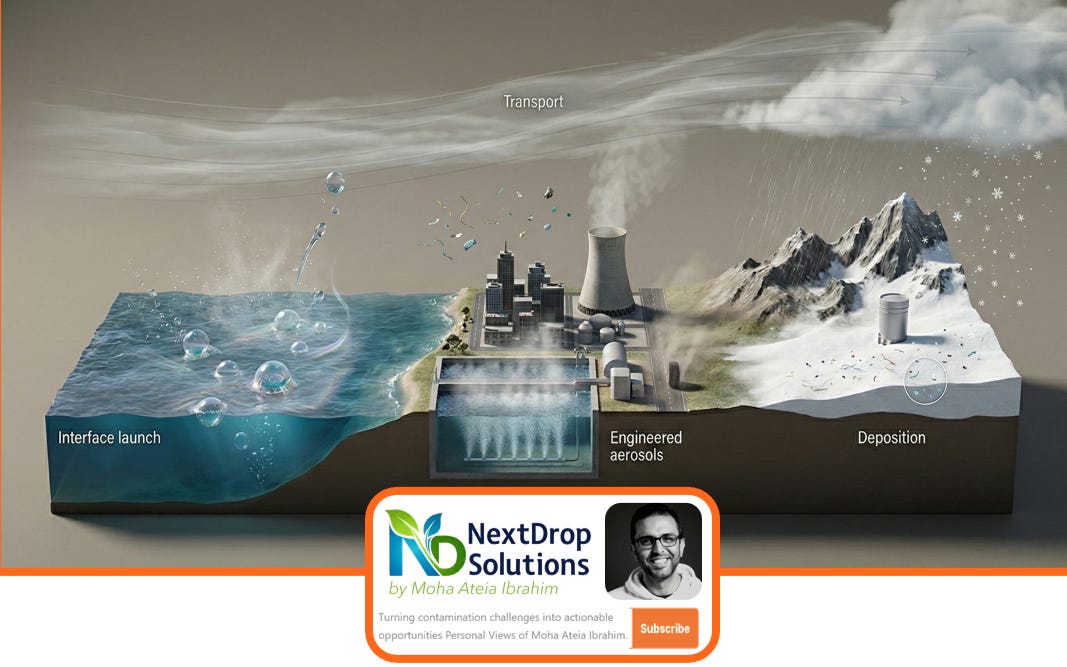
Actually, the strongest confirmed connection is physical, not chemical!
If you want a “confirmed connection” between PFAS and microplastics in air that does not rely on speculation, start with bubble bursting.
For microplastics, laboratory and modeling work has shown that bubble jet drops can scavenge and eject microplastics from the ocean surface into the atmosphere, and that the uncertainty in global emission estimates is driven less by the physics than by how poorly we know surface microplastic concentrations and size distributions.
For PFAS, the mechanism is even more tightly defined because PFAS are surface-active by design. Sea spray is not just salty water. It is a selective sampler of whatever likes the air–water interface. The Science Advances transect work quantified how strongly PFAAs partition into nascent sea spray aerosol and used those data to estimate that ocean-to-air re-emission can be comparable to, or greater than, other global atmospheric sources for certain legacy PFAAs.
This shared physics matters because it creates a feedback loop that looks like irreducible “background” to a regulator or a utility. We can reduce primary emissions, yet still see persistent deposition because the ocean and other reservoirs keep re-launching what they have accumulated. That is not defeatism. It is a mass-balance constraint.
The second confirmed connection is operational, as we aerosolize water on purpose
The uncomfortable extension is that many engineered systems recreate ocean-like aerosol generation at smaller scales.
Aeration basins, equalization tanks, industrial wastewater reactors, cooling towers, fountains, and even some stormwater structures all create bubbles, turbulence, and droplets. For PFAS, there is now experimental evidence that newer-generation perfluoroalkyl ether acids and sulfonates can transfer from aerated water into aerosols, with aerosolisation behavior influenced by functional group, chain length, and pH. Outdoor particulate-phase measurements have also been interpreted as consistent with wastewater processes, including activated sludge aeration, as potential contributors to airborne PFAS in PM.
For microplastics, the “aerosol generator” is often mechanical rather than interfacial: textile abrasion, drying, resuspension of settled dust, vehicle movement, and fragmentation of polymer-containing materials. The best indoor measurements now focus on the 1–10 µm size range because it is both inhalable and previously undercounted. A study using Raman microscopy reported median concentrations around 528 microplastic particles per m³ in residences and 2,238 per m³ in car cabins, with an exposure estimate of ~68,000 particles/day in the 1–10 µm fraction when combined with published datasets.
This doesn’t mean every aeration tank is a major emissions source, but we cannot keep doing PFAS and microplastics risk management with an implicit assumption that “water contamination stays in water.”
From a global view, we see the atmosphere is now a long-range conveyor for both.
Beyond coastal stories, global transport modeling has treated tire wear and brake wear particles as quantifiable sources and found high transport efficiencies to remote regions, including deposition to the Arctic Ocean. Field evidence now spans mountain catchments, protected areas, and polar environments, including Antarctic snow. At the same time, the field is wrestling with first-order budget questions, including how much the ocean contributes relative to land sources, and why different mechanistic and top-down approaches disagree.
PFAS, similarly, has matured beyond the “one or two chemicals” era. International governance already treats some PFAS as long-range transport pollutants, including under the Stockholm Convention’s rationale for listing PFOA and related compounds. The science is now filling in what “long range transport” means in practice: which PFAS are present in the gas phase as neutral precursors, which are particle-bound, how deposition varies with precipitation type, and how secondary sources such as sea spray reshape the global signal.
A key nuance here is chemical form. Many ionic PFAAs are not volatile, but they move efficiently when they hitchhike on particles and droplets. Many precursors are neutral and semi-volatile, so they can travel as gases and then oxidize into acids that deposit. That chemistry is one reason short acids and transformation products are showing up in places far from obvious point sources.
The third connection is a co-exposure story hiding in plain sight; textiles and indoor dust
If you want a connection between PFAS and microplastics that is both global and immediately actionable, look indoors.
Indoor microplastics are increasingly dominated by fragments and fibers in the respirable and inhalable size range, and people spend most of their time inside. In parallel, functional textiles remain a proven PFAS release pathway. In an outdoor aging study in Sydney, polyamide fabrics treated with side-chain fluorinated polymers released PFAS under realistic stressors, and subsequent abrasion and washing increased release.
Although, this alone does not prove that every airborne microfiber is a PFAS carrier, it does establish something more important for decision-making: the same product categories that generate microfibers and polymer fragments in air are also categories where fluorinated surface treatments have been used historically, and in some cases still are. Co-exposure is a design and procurement issue.
Why this matters for practice right now?
PFAS and microplastics did not suddenly appeared in air. The timing is that our thresholds, measurement capability, and policy ambitions have shifted into a regime where atmospheric transport becomes decision-relevant.
On PFAS, precipitation studies and reviews are now explicitly comparing rainwater concentrations to drinking-water benchmarks and highlighting that exceedances are most pronounced near sources, even when regional averages look lower. Meanwhile, North America is moving toward routine precipitation monitoring of PFAS through networks that were originally built for acid rain and mercury, which should change what “background” means in regulatory conversations.
On microplastics, the technical frontier has shifted toward smaller sizes, better polymer identification, and global transport modeling, all of which tend to increase estimated exposures and make local mitigation harder to dismiss as symbolic.
And for both, air is the compartment where “diffuse” becomes “inescapable” unless we identify controllable launch points.
What would we do differently as a scientists-engineers?
First, I would stop treating “air” as a single medium. For both PFAS and microplastics, the phase matters: gas, fine particles, coarse particles, droplets, settled dust, and wet deposition are distinct pathways with different controls and different health relevance. PFAS measurement methods for stationary sources are still maturing, but the direction is clear: we are building the metrology to take air emissions seriously.
Second, I would make aerosol-generating unit operations auditable. If a facility aerates PFAS-bearing water, I would want paired measurements in water, in near-field aerosols, and downwind deposition, at least as a screening exercise, before declaring “no air pathway.”
Third, I would treat indoor environments as part of the exposure portfolio, not a footnote. For many people, especially children, indoor air and dust are plausibly dominant for microplastic inhalation. For PFAS, textiles and consumer products remain a real and measurable source category, and the release behavior changes with aging and wear. The most cost-effective interventions may be procurement and material substitution, not end-of-pipe treatment.
Finally, I would be explicit about what is not yet confirmed. The idea that airborne microplastics act as significant long-range “vectors” for PFAS via sorption is mechanistically plausible and supported in other matrices, and the broader microplastic–PFAS interaction literature is growing. But direct, routine field measurements of PFAS mass associated with identified airborne microplastic particles are still thin. That is where “interesting hypothesis” should become “measurement campaign,” not a rhetorical flourish.